
Rush County Arrest Records and Court Charges
Arrest records in Rush County are created on the law-enforcement side. They may identify the person arrested, arresting agency, booking status, arrest date, charge wording used at booking, bond information, warrant basis, and whether the person was released, transferred, or held. The Rush County Sheriff is the first local contact for recent arrest and custody questions because no official county online jail roster was located in the research.
Court charge records begin when the prosecutor files or pursues formal counts in the court case. The County Attorney, not the jail roster, controls charging decisions in local state-law prosecutions. A booking charge can be different from the court charge, and a filed count can later be amended, reduced, dismissed, or resolved by plea or trial. For the full case file and outcome, use Rush County criminal court records.
Find Rush County Arrest Records and Charges
There is no official Rush County online arrest blotter or jail roster in the sources reviewed. For a recent arrest, call the Rush County Sheriff's Office and ask whether the person is held locally, released, transferred, or in another agency's custody. For filed court charges after arrest, search Kansas CaseSearch by defendant name or case number, then read the charge counts and docket events.
- For recent custody or booking status, contact the Rush County Sheriff with the full legal name and date of birth if known.
- For formal charges, search CaseSearch by defendant name or case number.
- Open the Rush County District Court case and review each count, statute, severity, and docket status.
- Compare filed charges with disposition entries before treating any charge as a conviction.
- Use the Clerk of the District Court for certified copies or documents missing from the online record.
The Rush County inmate records path is the better place for custody and jail-status questions. The court-charge path is for filed allegations and their case status.
Charges After Arrest
After an arrest or law-enforcement report, the prosecutor decides what, if anything, to file in court. Rush County uses a County Attorney for local prosecution. The official county attorney page lists Tony W. Rues at 111 W 3rd St, PO Box 780, La Crosse, phone 785-222-3736, and email trues@rushcountykansas.gov. That office is the charging authority for county state-law cases.
| Complaint | Information | Indictment | |
|---|---|---|---|
| Filed By | Prosecutor or authorized complainant | Prosecutor | Grand jury process |
| Common Use | Starts many criminal matters and states the charge | Formal prosecutor charging document | Less common local path for serious matters |
| What To Read | Charge wording, statute, count, and factual basis if public | Filed counts, severity, amendments, and prosecutor signature | Grand-jury charge counts and court filing details |
Rush County Charge Status
Charge status changes as a case moves through court. A count can start as pending, be amended to a different statute, be reduced through plea negotiation, be dismissed, or end in a conviction. Kansas dockets may show pleas, journal entries, sentencing events, financial balances, and later probation or warrant activity. Read the current status and disposition for each count, not just the first charge list.
| Status | What It Means |
|---|---|
| Pending | The charge has been filed or is active, but no final disposition has been entered. |
| Amended | The prosecutor or court record changed the charge wording, statute, count, or severity. |
| Reduced | The case resolved or moved forward on a lesser charge than originally filed. |
| Dismissed | The count or case was terminated without a conviction on that count. |
| Diversion | A prosecutor-approved program may lead to dismissal if conditions are completed. |
| Convicted | A guilty plea or verdict created a conviction, followed by sentence or other judgment. |
Charge vs Conviction
Being charged is not the same as being convicted. A Rush County arrest record may use initial charge wording from booking. A court record may show the prosecutor's filed count. A conviction appears only after a guilty plea, guilty verdict, or other conviction event. The distinction matters for background review, employment forms, licensing, housing questions, and personal record checks.
| Charge | Conviction | |
|---|---|---|
| Record Stage | Arrest, complaint, information, or early docket | Disposition, judgment, plea, verdict, or sentencing |
| Meaning | An allegation that must still be resolved | A final guilty result on a count |
| Can Change | Yes, through amendment, reduction, or dismissal | Can be appealed, corrected, or later expunged if eligible |
| Where To Verify | CaseSearch docket and filed charging document | Disposition, journal entry, sentencing order, and certified copy |
Rush County Arrest Records Source
The Rush County Sheriff is Mark Knowles. The official sheriff page lists the office at 715 Elm, PO Box 495, La Crosse, phone 785-222-2578, fax 785-222-3328, and email sheriff@rushcountykansas.gov. Staff listed by the county include sheriff, undersheriff, deputies, patrol staff, and 911 communications staff. The sheriff office is the local access point for arrest, incident, public safety, and warrant questions.
The official Rush County Sheriff page gives local office contacts and links to public safety resources.
Sheriff information helps confirm the arrest side, but filed court charges still need court or prosecutor records.
Charge Codes and Severity
Kansas criminal charge entries may include statute number, count number, charge description, offense date, severity or class, arresting agency, amended charge, dismissed charge, and conviction charge. A single arrest can produce multiple counts. Each count should be read on its own because one count can be dismissed while another ends in conviction or diversion.
The Rush County Sheriff services page describes the sheriff's public safety mission and local law-enforcement role.
That law-enforcement role begins the arrest record, but the filed charge code is checked against the district court case.
Statewide Charge Record Checks
The KBI/Kansas.gov criminal history search is a statewide background record, not a live court docket. The research source lists a $30 Kansas.gov purchase price and a maintenance window from midnight to 4 a.m. Central. The KBI registered offender search is also separate. It is a registry search after a disclaimer, not a complete criminal history and not proof of current custody.
The KBI registered offender search can identify registry information where applicable.
Registry data should be kept separate from ordinary arrest records, charge records, and court convictions.
The KBI Kansas Most Wanted page is a statewide wanted-person source, not a complete Rush County warrant or charge database.
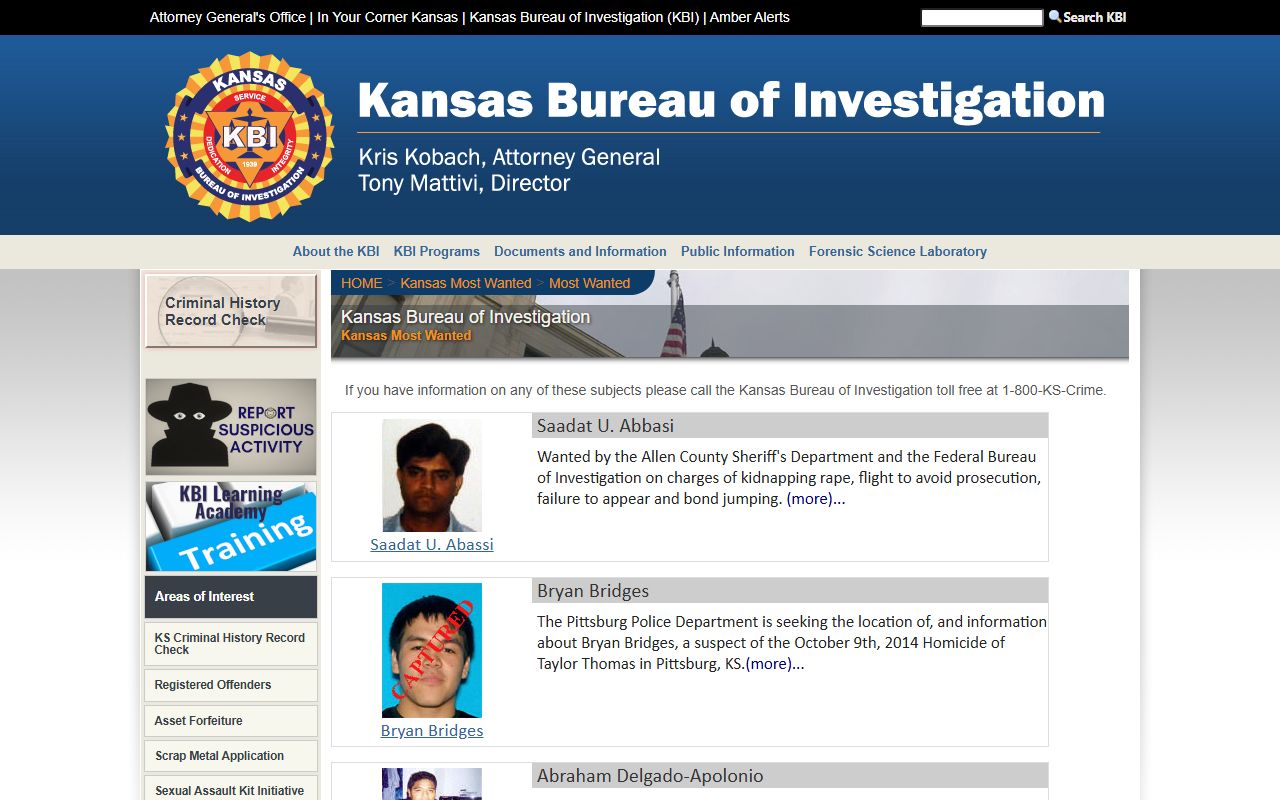
Most-wanted listings can support a public safety check but do not replace sheriff, court, or prosecutor records for charge status.
Sealed and Expunged Charges
Some charge and arrest records are not public. Juvenile records, sealed cases, unexecuted or sealed warrants, protection matters, confidential victim details, and expunged arrest records may be withheld from public internet access. K.S.A. 21-6614 allows eligible people to petition the convicting court for expungement of certain convictions, arrest records, and diversion agreements after waiting periods and sentence completion.
| Sealed | Expunged | |
|---|---|---|
| Public Access | Closed by law, rule, or court order | Limited after a successful petition |
| Applies To | Confidential filings, juvenile matters, sealed warrants, or protected information | Eligible arrest records, convictions, and diversion agreements |
| Where To Ask | Clerk of the District Court or issuing court | The court that handled the case or arrest record petition |
Sheriff App and Record Requests
The Rush County Sheriff's Office app exists for public safety communication. The official Google Play listing says residents can report crimes, submit tips, use interactive features, and receive public safety news and information. The research did not confirm an app-only jail roster, warrant search, or court-charge lookup, so the app should not be treated as a substitute for sheriff or court records.
A KORA request to the sheriff may be needed for arrest reports, booking records, incident records, or jail logs not online, subject to exemptions. For filed court charges, use the district court record request route. For prosecutor decisions, contact the County Attorney. For city ordinance citations, contact the municipal court or city office named on the citation.
Restricted Rush County Arrest Records
Rush County arrest records and court charges can be limited by ongoing investigations, juvenile law, sealed court orders, expungement, confidential victim information, and law-enforcement exemptions. A court docket may show a warrant return after execution, but unexecuted search warrants and sealed warrants are commonly not available to the public.
Always match the record type to the office. Sheriff records answer arrest and custody questions. CaseSearch and the Clerk of the District Court answer filed charge and disposition questions. KBI criminal history answers statewide repository questions. KDOC tools answer sentenced state-prison custody questions.
Note: A booking charge, filed court charge, and conviction are three different record points.